
 Inspection and Testing

Shipping containers have become one of the most flexible building blocks in the UK, used for everything from garden storage to full self storage sites. But before you place one on your land, it's worth knowing where you stand with planning permission.
The short answer is: it depends. Size, location, how long the container will stay, and what you're using it for all play a part. This guide breaks down what determines whether you need permission, when you're likely to be exempt, and how the rules apply across different container builds.
Is a shipping container a temporary or permanent structure?
Under UK planning law, a shipping container is usually treated as a structure rather than a building. Because it's portable, not fixed to a foundation, and can be lifted away as easily as it arrived, most councils view it in the same category as a static caravan or portable cabin: something temporary.
That classification matters, because permitted development rights are built around temporary and incidental structures. The catch is that “temporary” isn't just about the physical build. The longer a container sits in one place, and the more it looks and functions like a permanent fixture (connected to power and drainage, sat on a concrete base, or converted into living space), the more likely a planning officer is to treat it as permanent, and therefore subject to full planning rules.
What determines whether your container will need planning permission?
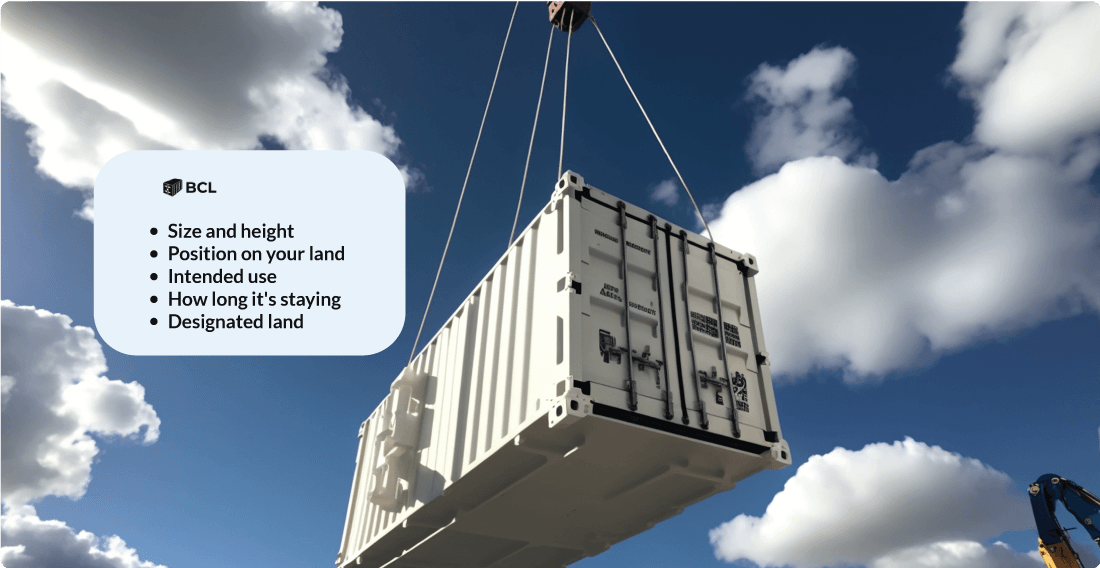
A handful of factors decide whether you'll need to apply to your local authority before your container goes in.
Size and height - Containers under 2.5 metres high, positioned away from boundaries, are far more likely to fall under permitted development than a stacked or oversized unit. Our guide to shipping container sizes can help you work out what footprint you're dealing with.
Position on your land - A container tucked to the side or rear of a property is treated very differently to one placed in front of the building line or in a highly visible spot.
Intended use - Storage and other purposes incidental to a home or business usually need no permission. Living in a container, running a business from it, or opening it to the public changes that.
How long it's staying - Short term placements can fall under the 28 day rule (more on that below). Anything left indefinitely is judged differently.
Designated land - Conservation areas, National Parks, Areas of Outstanding Natural Beauty and the curtilage of listed buildings all carry tighter restrictions, and permitted development rights are often reduced or removed altogether.
If you're unsure how your project stacks up, it's always worth a quick call to your local planning authority before your container is delivered.
When a shipping container doesn't need planning permission
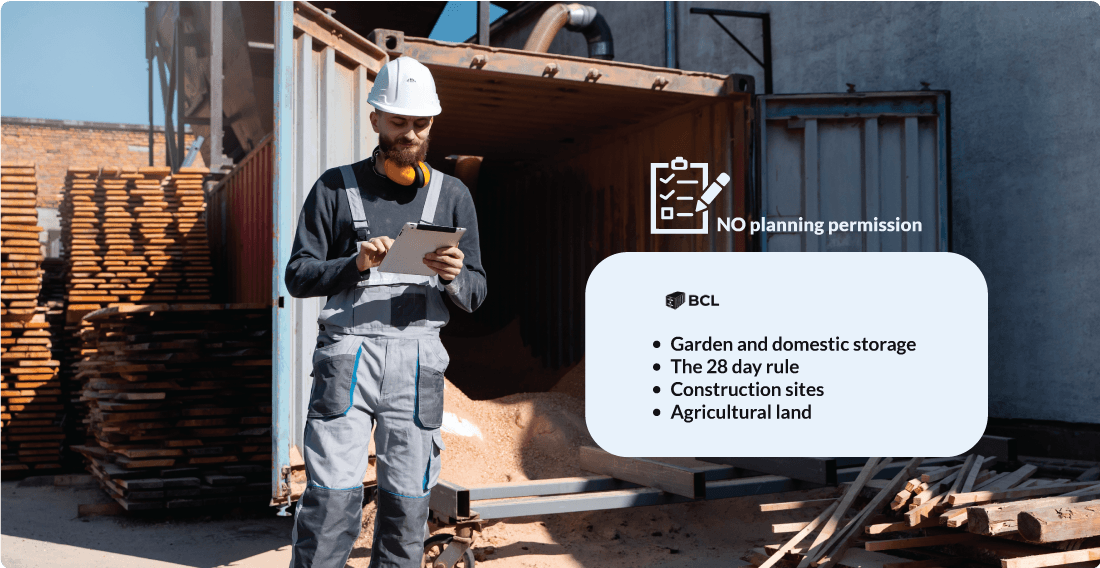
In many cases, a shipping container can go in without a formal planning application, provided you stay within permitted development limits.
Garden and domestic storage - Under Part 1, Class E of the GPDO, containers used for storage or other purposes incidental to a house are generally permitted, provided they meet height and coverage limits and sit outside the front of the property.
The 28 day rule - Land can be used for temporary purposes, including housing a container, for up to 28 days per calendar year without planning permission. This is commonly used for events, seasonal storage, or short projects.
Construction sites - Containers used for site storage or welfare facilities during active building work are usually covered under permitted development, as long as they're removed once the project is finished.
Agricultural land - Farmers benefit from wider permitted development rights, and containers used purely for agricultural purposes can often go ahead without an application, though larger holdings may still need prior approval.
These exemptions are the norm rather than a loophole, but they only apply if you stay inside the conditions. Push past them (a bigger footprint, a more permanent fixing, a change of use) and permission is likely to be required.
When a shipping container does need planning permission
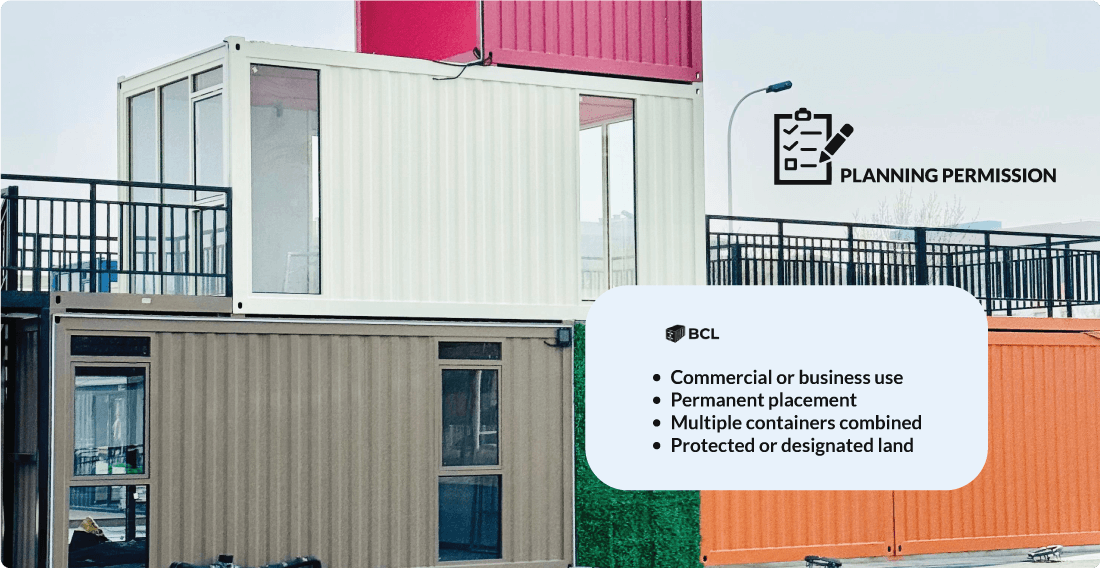
Permission becomes far more likely once your container moves outside “incidental” or temporary territory.
Commercial or business use - Storage businesses, workshops, retail units and similar commercial operations almost always require planning permission, even if the containers themselves are portable.
Permanent placement - A container fixed to a foundation, connected to mains services, or intended to stay indefinitely is treated as a permanent structure.
Multiple containers combined - Joining several containers to form a larger unit, such as a block of offices or a bigger storage facility, counts as new development in its own right.
Protected or designated land - Conservation areas, National Parks, AONBs and land near listed buildings carry stricter controls, and what would normally be permitted development elsewhere may need a full application here.
Getting this wrong isn't a small risk. Councils can issue enforcement notices, and in England the enforcement period for most planning breaches now runs to ten years. It's always cheaper to check first than to argue your case after the container has already been delivered.
Planning permission for different types of container builds
Planning permission doesn't work the same way for every container project. What you're building it for changes the picture considerably, so here's how the rules tend to play out across a few of the builds we work on most.
Shipping container turnstiles
Shipping container turnstiles are usually installed for a defined purpose: managing access to a construction site, an event, or a stadium for a set period of time. Because they're self contained, portable, and typically removed once the project or event ends, most turnstile installations fall under permitted development.
Where this can change is with permanence. A turnstile unit that's bedded onto a concrete base, wired into a fixed power supply, or intended to stay on site indefinitely starts to look like a permanent structure in the eyes of a planning officer, and may need an application. If you're planning a long term access control point rather than a temporary one, it's worth checking with your local authority before the unit is built.
Shipping container storage and self storage
A single container used for personal storage in a garden is one thing. A self storage business built from multiple storage containers is another entirely.
Because a commercial storage site involves a change of use, ongoing customer access, and often groundworks for surfacing and security, planning permission is almost always required, regardless of how portable the individual containers are. This applies whether you're starting with five containers or fifty. We'd always recommend speaking to your local planning authority before committing to a site, since undoing a mistake after containers have been delivered is a costly exercise.
Shipping container garden rooms
Garden rooms sit closer to the “doesn't need permission” end of the scale, provided they stay within the same rules as any other outbuilding. Kept under 2.5 metres in height near a boundary, positioned to the side or rear of the property, and used for a purpose incidental to the home, such as a home office, gym, or man cave, most garden room conversions fall under permitted development.
That changes if the room is used as separate living accommodation, sits forward of the house, or takes up more than half the garden alongside other outbuildings. Conservation areas and other designated land also reduce what's automatically allowed, so it's worth checking your property's status before committing to a design.
Speak to BCL containers about your project
Every container project is different, and planning rules can shift depending on your council, site, and project. BCL containers has been designing and building bespoke container solutions for over 50 years, and we can talk you through how your project is likely to be viewed before you commit to your design.
Every unit we build runs through the same process, from initial design through in-house fabrication and quality assurance, so what leaves our facility is ready to work.
Get in touch with our team to discuss your project, or explore our container conversions to see what’s possible.