
 Inspection and Testing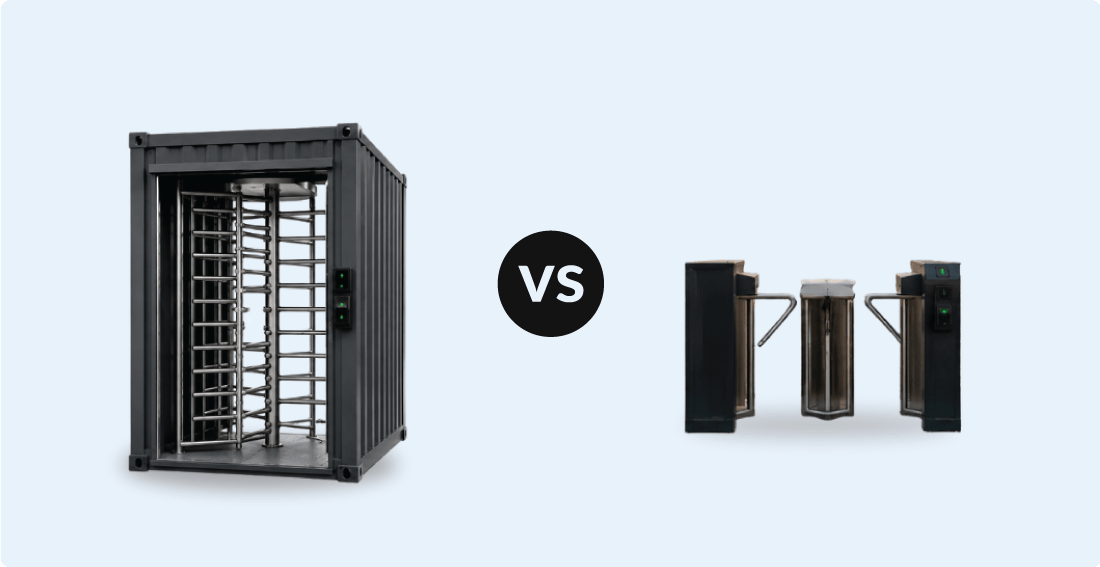

Turnstiles come in two main formats, and the choice between them has a real impact on how well your access control system performs.
Full height and waist height turnstiles do different jobs, suit different environments, and come with different trade-offs on security and throughput. Understanding the difference helps you specify the right unit before it arrives on site.
How full height and waist height turnstiles differ
A full height turnstile is a floor-to-ceiling rotating barrier, typically standing around two metres tall, with rotor arms that extend the full height of the unit. A person passes through by pushing against the arms, which rotate only when a valid credential has been presented to the reader. Once through, the arms lock again behind them.
A waist height turnstile, sometimes called a half height or tripod turnstile, sits at around one to 1.2 metres tall and uses three rotating arms at waist level. The mechanism is the same: credential in, rotor releases, one person passes. The difference is what the unit prevents physically.
Tailgating, throughput and security trade-offs
This is where the two formats diverge most sharply.
A full height turnstile cannot be climbed over without significant effort, and it cannot be tailgated without physically forcing the rotor. It provides a genuine physical barrier and is the appropriate choice wherever preventing unauthorised entry is the primary objective.
A waist height turnstile can, in principle, be stepped over or bypassed by a determined individual. It is not primarily a security barrier, it is an access management and logging tool.
Its value is in tracking who passes through and deterring casual tailgating, not in physically preventing someone from getting in.
On throughput, waist height units are considerably faster. They suit high-volume entry points where queues during peak periods are a real operational problem.
When full height turnstiles are the right choice
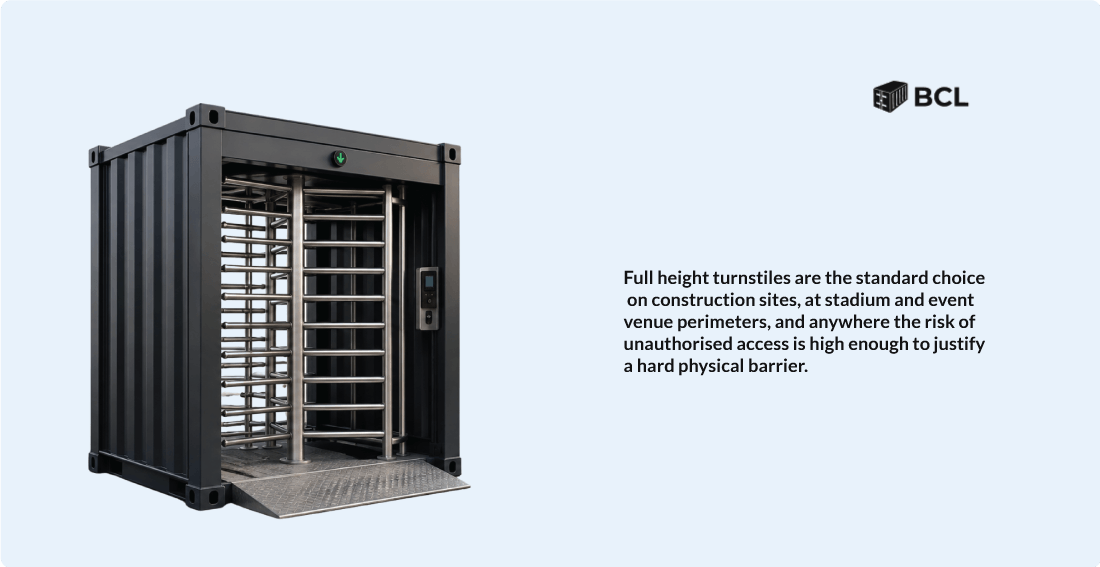
Full height turnstiles are the standard choice on construction sites, at stadium and event venue perimeters, and anywhere the risk of unauthorised access is high enough to justify a hard physical barrier.
On a construction site, a full height unit at the main entry point satisfies the requirement under CDM 2015 to take reasonable steps to prevent unauthorised access. It is difficult to bypass, creates a clear record of every entry, and deters the kind of opportunist access that leads to theft, vandalism and unaccompanied visitors in a hazardous environment. Our construction site access control guide covers the CDM 2015 duty and how access control satisfies it in more detail.
For events and festivals, full height turnstiles at the outer perimeter prevent gate-crashing at the boundary, while faster waist height units can be used at internal zone transitions where security demands are lower. We cover this in our festival access control guide.
When waist height turnstiles make more sense
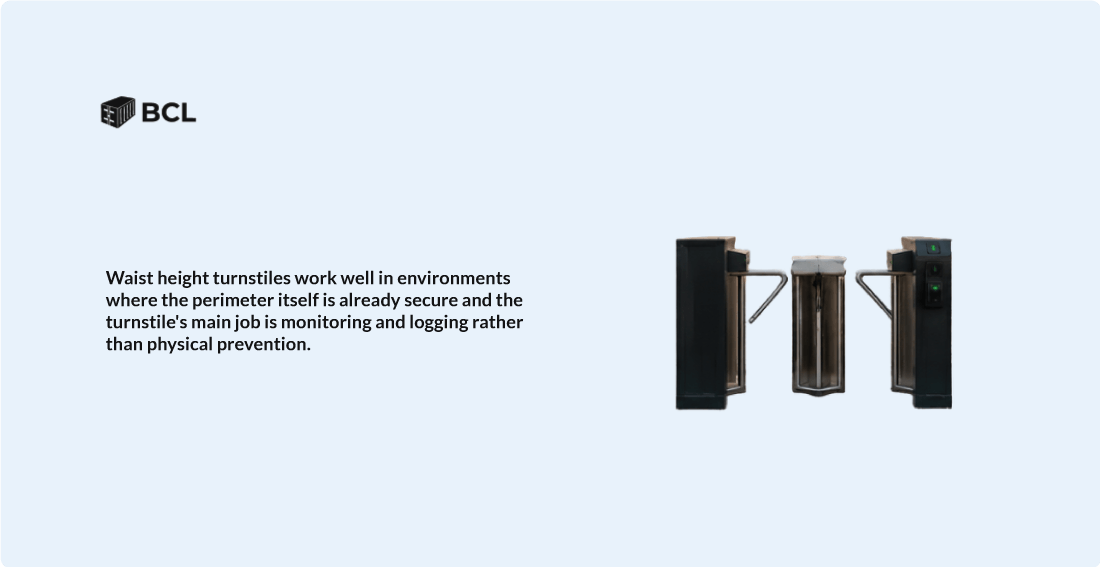
Waist height turnstiles work well in environments where the perimeter itself is already secure and the turnstile's main job is monitoring and logging rather than physical prevention.
An office building with a secured entrance already controls who reaches the turnstile. The unit then acts as a time and attendance tool and a deterrent to tailgating, rather than a primary security barrier. In this context, the faster throughput and more compact footprint of a waist height unit is an advantage.
On larger construction sites, waist height units are often placed at secondary entry points or internal zone boundaries, with full height units reserved for the main site entrance.
Specifying your turnstile: What else to consider
Once you have settled on the format, there are practical questions that shape the rest of the specification.
How many lanes do you need? At peak shift change, a single turnstile lane can become a bottleneck quickly. Planning for two or more lanes from the outset is considerably easier than adding capacity later.
What credential technology will it use? RFID, CSCS card verification, biometrics or a combination all have different implications for the reader specification and the software behind it.
How long will it be on site, and across how many projects? For a single short-term deployment, hire is straightforward. For contractors moving across multiple sites, owning the infrastructure is worth examining carefully.
Container turnstiles for either format
A shipping container turnstile can be built around full height or waist height mechanisms, or a combination of both within the same unit. Because each unit is a bespoke conversion, the format, lane count, credential technology and internal fit-out are all specified upfront rather than chosen from a fixed catalogue.
The result is an access control unit built for your site, in a format you own and can redeploy. You can see an example of this type of build in one of our recent projects.
To discuss the right specification for your next project, get in touch with our team.