
 Inspection and Testing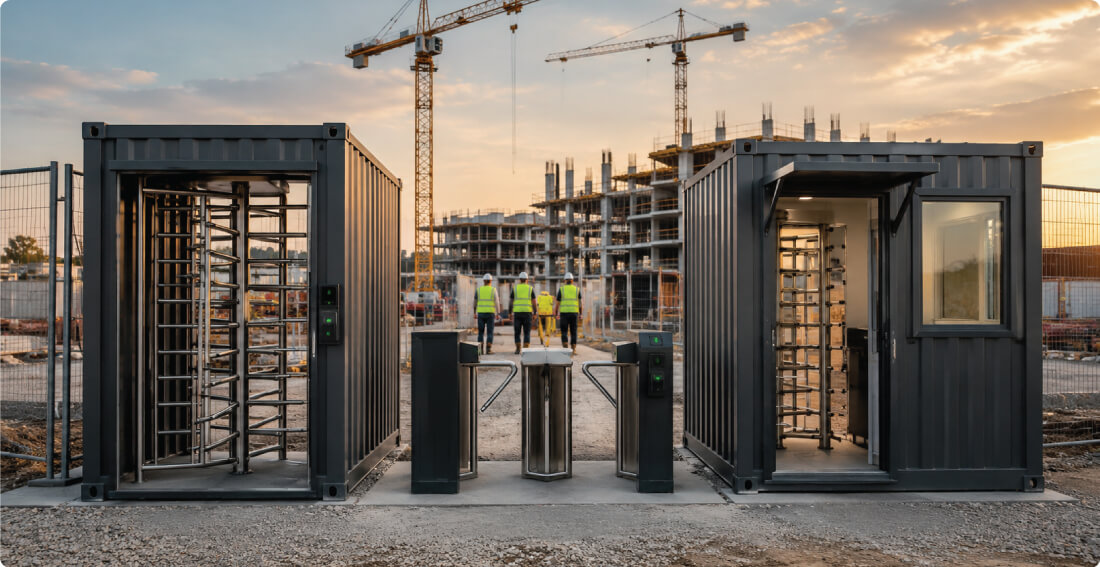

Every construction site needs a controlled entry point. Not just for security, but for compliance, workforce management, and insurance. This guide covers the key decisions UK site managers need to make when specifying access control for a construction project.
What CDM 2015 requires from principal contractors
The construction (design and management) regulations 2015 are the starting point for any discussion about construction site access control. Regulation 13 places a specific duty on the principal contractor to take reasonable steps to prevent unauthorised people from accessing the site.
The duty is not optional, and it applies regardless of the project size. In practice, it means a secure perimeter, a controlled entry point, and an auditable record of who has passed through it.
How access control satisfies your legal duty
A turnstile-based access control system is the standard way of evidencing that duty has been met on UK construction sites. It creates a physical barrier at the entry point, validates credentials before granting access, and produces a timestamped log of every entrance and exit.
This log is useful beyond compliance. In the event of a site incident, fire evacuation, or an insurance claim, the access record is often the first piece of evidence requested.
The main types of construction site turnstile
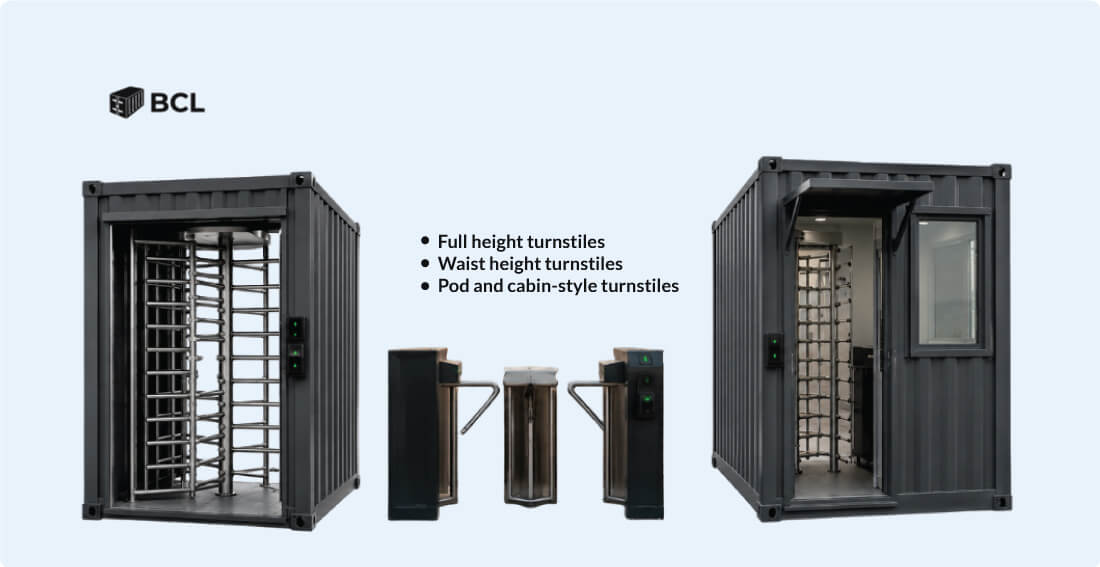
There are three turnstile types commonly used on UK construction sites, and the right choice depends on your site’s security requirements, footfall, and project duration.
Full height turnstiles create a complete physical barrier. They can’t be climbed over or tailgated, and they are the standard choice for sites where security is the primary concern. They process one person at a time, so they suit entry points with steady throughput rather than large shift-change peaks.
Waist height turnstiles are faster and more compact. They allow higher throughput and are commonly used on sites where the perimeter hoarding is the primary security and the turnstile is mainly logging workforce movement for payroll and safety purposes.
Pod and cabin-style turnstiles combine one or more turnstile mechanisms inside a prefabricated unit. They can be deployed rapidly, often without groundworks, and are popular on sites where access control infrastructure needs to be operational in a short space of time.
Full height vs waist height: which does your site need?
This decision usually comes down to security versus throughput. Full height is the stronger security option. Waist height is the more practical choice where volume is high and the perimeter itself is doing most of the security work.
Many larger sites use a combination: full height at the main pedestrian entry and waist height at secondary points.
Credential technology: Cards, CSCS and biometrics
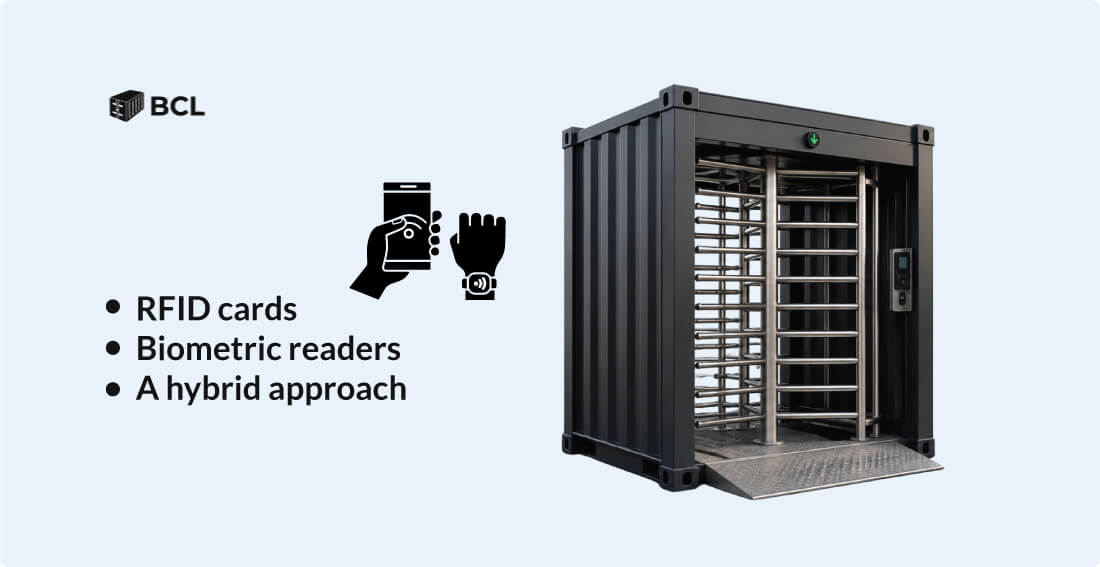
The turnstile controls who passes through. The credential technology determines how it decides who that should be.
Three credential types are widely used on UK construction sites.
RFID cards are the most common. Workers present a contactless card or fob to a reader at the turnstile. Most modern systems can use a worker's existing CSCS card as their site credential, avoiding the need to issue a second card. CSCS Smart Check allows the card to be verified in real time against the national database, so expired or fraudulent cards are flagged and blocked at the gate rather than waved through.
Biometric readers use fingerprint or facial recognition to verify identity without a physical card. They eliminate buddy clocking, where one worker presents credentials on behalf of another, and remove the risk of lost or transferred cards. Biometric data is classified as special category data under UK GDPR, so its use on site requires a data protection impact assessment and a clear lawful basis.
A hybrid approach is common on larger sites: biometric verification for the regular workforce and RFID cards for visitors, short-term contractors and deliveries.
Hire or own your turnstile infrastructure?
Most construction site turnstiles in the UK are hired. A supplier delivers the unit, maintains it during the project and collects it at the end. For a single short-term project, that makes sense. There is no capital outlay and the supplier handles the technical side.
The problem is that hire costs accumulate across projects. If you are running multiple sites or returning to the same type of project year after year, you are paying repeatedly for infrastructure you will never own.
Why a container turnstile changes the calculation
A shipping container turnstile is a turnstile system built into a converted shipping container and purchased outright rather than hired. Once the project is complete, the unit is lifted onto a flatbed and redeployed to the next site.
Across multiple projects, the economics are straightforward. The upfront cost is higher than a single hire, but the total cost of ownership across two or three projects is typically lower. The unit also remains configured to your specification throughout: the credential technology, lane count and internal fit-out do not change between deployments.
For contractors who move from site to site, owning the access control infrastructure is worth considering seriously. You can see an example of this type of unit in one of our recent turnstile projects.
What to look for when specifying a site turnstile
Before committing to a solution, the practical questions to work through are:
How many entry lanes do you need at peak shift-change periods?
What credential type suits your workforce and your existing induction platform?
Does the unit need to integrate with time and attendance or paywall software?
Is the project short-term or long-running, and does that affect hire vs ownership?
Can the unit be delivered and operational before the first workers arrive on site?
Getting these right before work starts is considerably easier than trying to fix them once the site is live.
To discuss access control for your next project, get in touch with our team today.