
 Inspection and Testing

The Construction (Design and Management) Regulations 2015 are the framework that governs health and safety management across UK construction projects. Site managers are broadly familiar with CDM, but the specific duty around access control is often less well understood than it should be.
This article covers what the regulations actually say, what the HSE expects to see, and how a turnstile-based system satisfies the legal requirement.
What Regulation 13 requires from principal contractors
Regulation 13 of CDM 2015 sets out the duties of the principal contractor during the construction phase. Among these is a specific obligation that sits directly alongside daily site management: Regulation 13(4)(b) requires that the principal contractor takes reasonable steps to prevent access to the construction site by unauthorised persons.
That duty applies to every principal contractor on every notifiable project. It is not conditional on project size, location, or the level of public risk. It is a standing obligation that must be evidenced throughout the construction phase.
Defining “reasonable steps” to prevent unauthorised access
The regulations do not prescribe exactly what “reasonable steps” means. That is deliberate: the HSE expects the level of control to be proportionate to the risk presented by the site.
A small groundworks project on an isolated rural site may need less infrastructure than a large city-centre build surrounded by members of the public. What matters is that the steps taken are appropriate to the risk and that they can be evidenced if challenged.
In practice, the HSE’s own public protection guidance makes clear what it expects on sites in populated areas: a secure perimeter and a controlled entry point. A turnstile at the site entrance, logging who enters and when, is the standard way of satisfying that expectation. The format of that turnstile (full height or waist height) depends on the specific security requirements of the site.
What the HSE expects to see on site
When an HSE inspector visits a construction site, the access control setup is one of the first things assessed. The inspector is looking for evidence that unauthorised access has been genuinely prevented, not just discouraged.
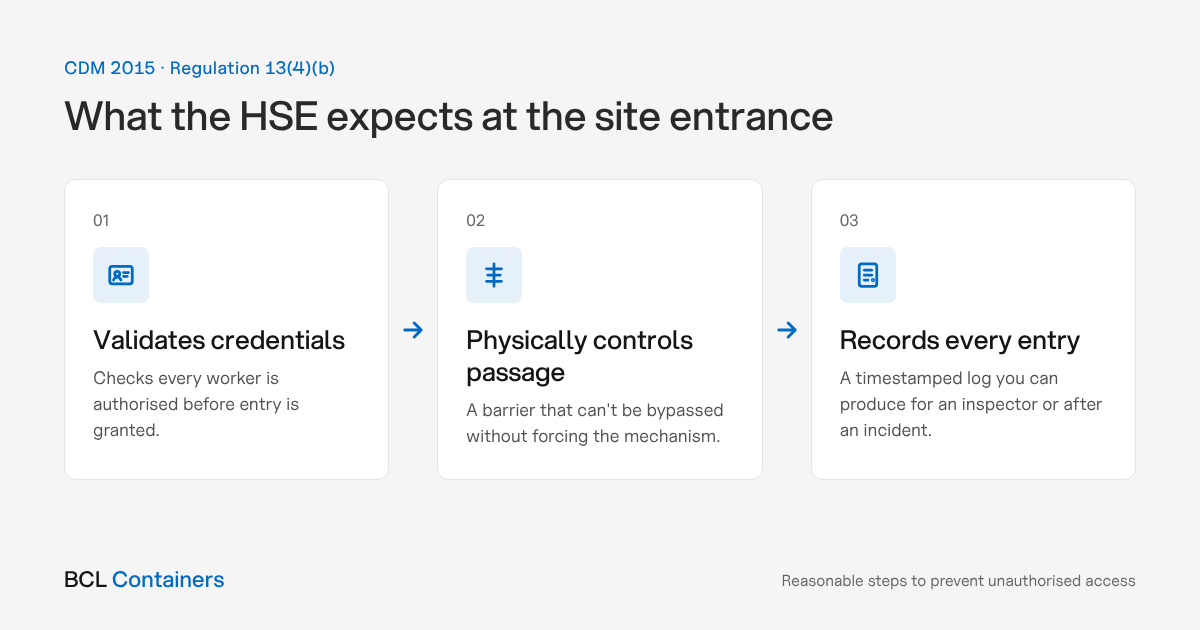
A hoarding around the site perimeter addresses the boundary. But a gap in the hoarding with a site agent waving people through does not constitute a controlled entry point in the way the HSE intends. What an inspector wants to see is a system: something that validates credentials, physically controls passage, and produces a record of every person who has passed through.
That record matters independently of any inspection. If an incident occurs on site, such as a theft, an injury, or an emergency evacuation, the access log becomes an immediate reference point. It tells you who was on site, when they arrived, and whether they had valid credentials. Our construction site access control guide covers the full picture of how access control systems are structured and what components they include.
How a turnstile satisfies your CDM 2015 duty
A turnstile installed at the site entry point addresses the Regulation 13 duty in a straightforward and auditable way. It creates a physical barrier that cannot be bypassed without forcing the mechanism, validates credentials before granting entry, and produces a timestamped log of every access event.
That combination is what the HSE is looking for: control that is active rather than passive, and evidence that can be produced on demand.
Why physical barriers matter more than manned entry
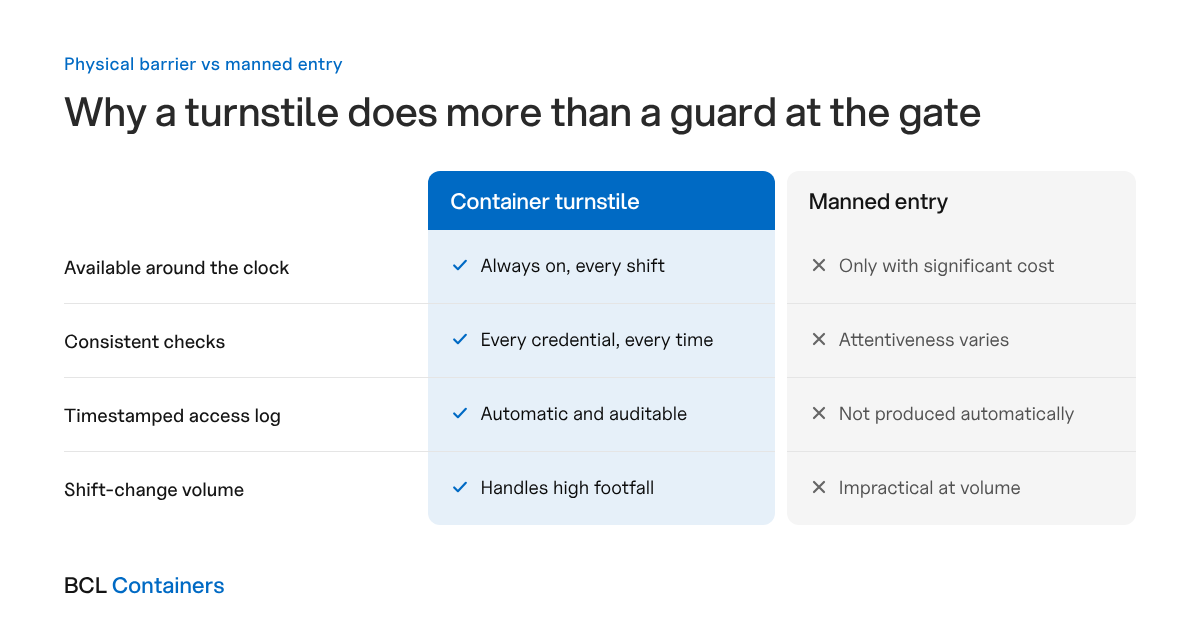
A security guard at the gate can check credentials and refuse entry. But manned entry has limitations that a turnstile does not. A guard cannot be present at all times without significant cost. Attentiveness varies. And a manned entry point does not automatically produce the kind of detailed access log that satisfies an audit or supports an insurance claim. We look at this comparison in more detail in our article on container turnstiles vs portable gatehouses.
A shipping container turnstile combines the physical barrier, the credential reader and the access log in a single unit. Entry is only granted when the system is satisfied, not when a person is. That distinction matters most on high-footfall sites during shift changes, when manual checking becomes impractical at volume.
Choosing access control that evidences compliance
The practical question for a principal contractor is not just whether access control has been installed, but whether it produces the evidence that demonstrates the Regulation 13 duty has been met.
A system that logs entries with timestamps, validates credentials in real time, and creates a retrievable audit trail does that job. A system that relies on a guard’s memory does not.
If you are specifying access control for an upcoming project and want to make sure it satisfies CDM 2015 requirements, get in touch with our team. We can talk through what the site needs and what a container turnstile unit would look like for your specific setup.