
 Inspection and Testing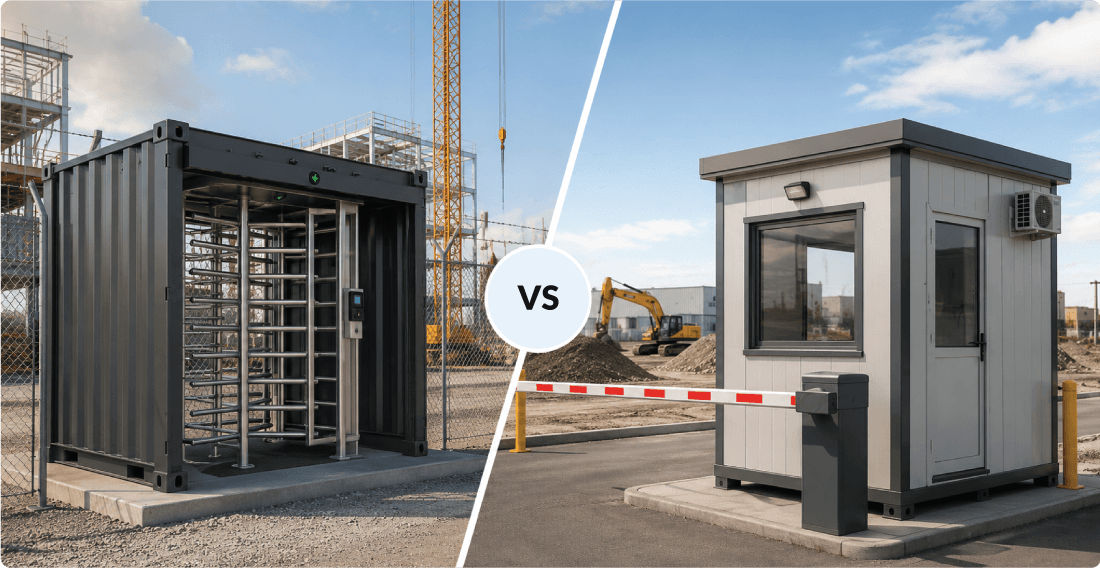

When it comes to controlling who gets onto a construction site, two solutions come up consistently: the portable cabin gatehouse and the container turnstile.
They're both described as site access solutions, but they work in fundamentally different ways. Understanding that difference is what helps you choose the right one.
What good site access control actually looks like
Site access control isn't just about knowing who's on your site. It's about physically preventing those who shouldn't be there from getting in, logging entries accurately, and doing both at volume without creating a bottleneck at the gate.
A solution that ticks all three of those boxes is what you're after. One that does one but not the others will cause problems sooner or later, and ultimately won’t be worth your investment.
CDM 2015 and your duty to prevent unauthorised access
Under the Construction (Design and Management) Regulations 2015, principal contractors have a legal duty to prevent unauthorised access to their sites. This applies to projects of all sizes and means your entry point needs to be appropriate for the scale and footfall of the work.
Meeting that duty means more than having someone on the gate. It means having a reliable, documented system for controlling and recording who passes through.
How a portable cabin gatehouse works
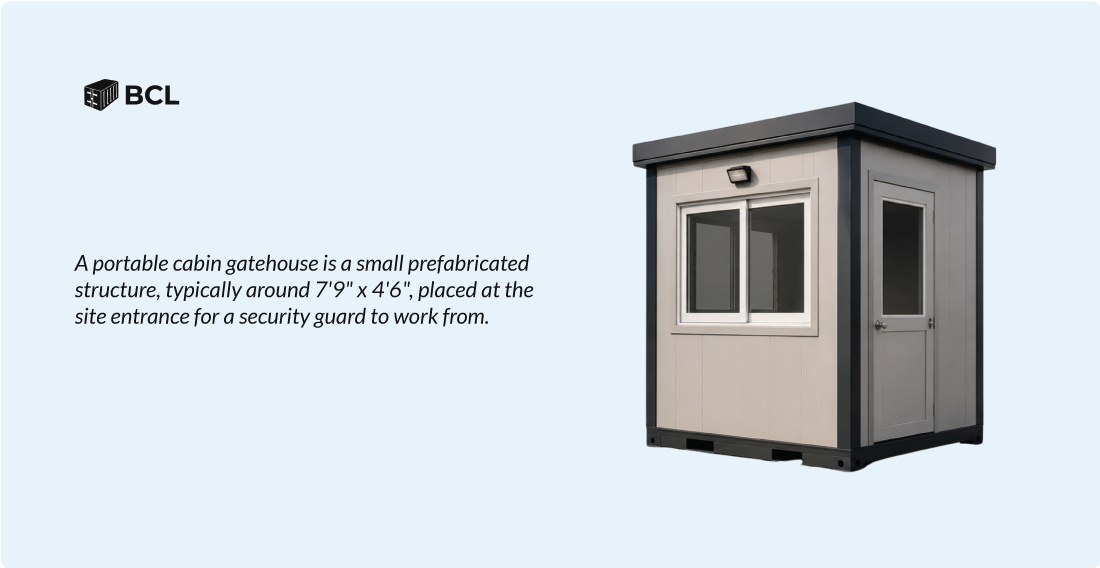
A portable cabin gatehouse is a small prefabricated structure, typically around 7'9" x 4'6", placed at the site entrance for a security guard to work from. The guard checks credentials, permits entry, and logs who's coming in and out.
For small, low-footfall sites with a modest budget and short project duration, it does the basic job. The unit is hired, delivered, and collected when you're done. There's no capital outlay and no long-term commitment. However, they’re not necessarily best-suited to many situations.
Where manned entry points fall short
The core limitation of a gatehouse is that it relies entirely on the person inside it. If the guard is distracted, fatigued, or simply not present, access control breaks down. There's no physical barrier preventing anyone from walking past, and no automated record of who has actually entered the site.
During shift changes or busy periods, a single manned point becomes a bottleneck. It also doesn't lend itself well to integration with modern access control technology. Retrofitting RFID or biometric readers to a hired cabin is rarely straightforward, and the unit itself goes back to the hire company at the end of the project.
Why a container turnstile is the stronger option
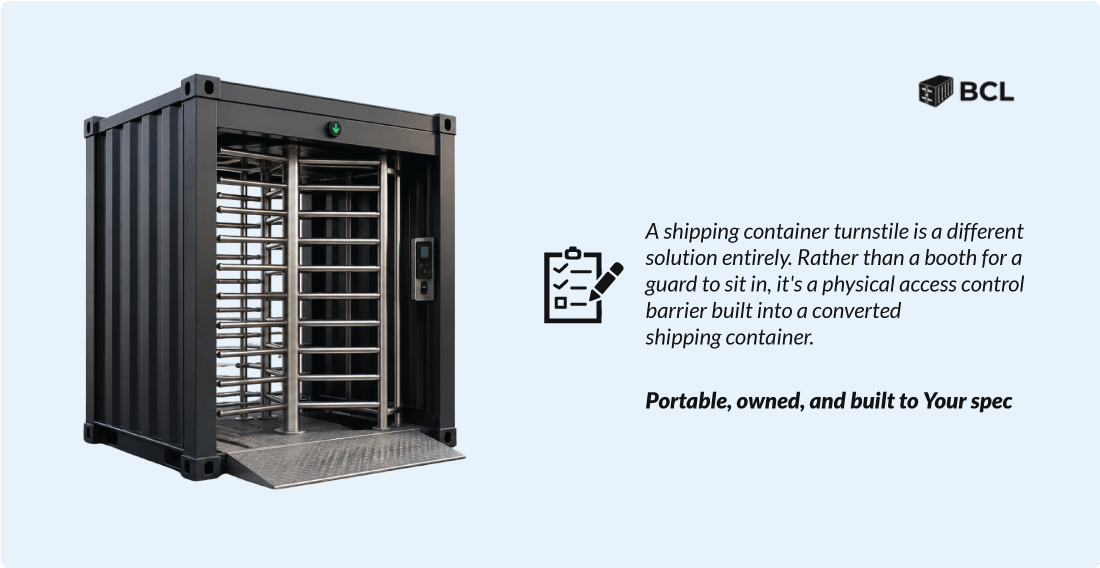
A shipping container turnstile is a different solution entirely. Rather than a booth for a guard to sit in, it's a physical access control barrier built into a converted shipping container. The container channels foot traffic through a turnstile gate, and nobody passes through without a valid entry signal.
That signal can come from a guard operating the unit manually, or automatically via an integrated access control system. Either way, the turnstile creates a barrier that can't be bypassed by simply walking past.
For construction sites managing large workforces, multiple shift patterns, or strict CDM compliance requirements, that distinction matters. Every entry is physically controlled and logged. There's no gap in the system when attention lapses.
Portable, owned, and built to Your spec
One of the most practical advantages of a container turnstile is that you own it. Unlike a hired gatehouse that goes back to the supplier at the end of the project, the container unit is yours. When the job is done, it can be lifted onto a flatbed and deployed on your next site. Across multiple projects, that makes the economics significantly more attractive than repeated hire.
The unit is also built to your exact requirements from the outset. Number of lanes, access control technology, internal fit-out, electrics, and livery are all specified upfront rather than worked around afterwards. You can see the kind of work we produce in one of our recent container turnstile projects.
Integrating access control technology
Because a container turnstile is built as a bespoke conversion, access control technology is designed into the unit from the start, not added as an afterthought. This makes a significant difference to what you can integrate and how reliably it works.
RFID, CSCS cards and biometric access
Depending on your site requirements, we can incorporate:
RFID card readers, including CSCS card validation for construction site compliance
Biometric terminals using fingerprint, palm, or facial recognition
QR code scanners for event and visitor management
Manned stations for ticketed or manually controlled entry
The result is a unit that handles access control automatically, generates an accurate record of every entry, and does so without relying on constant human oversight.
Get in touch for a bespoke shipping container turnstile unit
If you're working out the right access control solution for an upcoming project, get in touch with our team. We'll talk through your site requirements and give you a straight answer on what we can build.