
 Inspection and Testing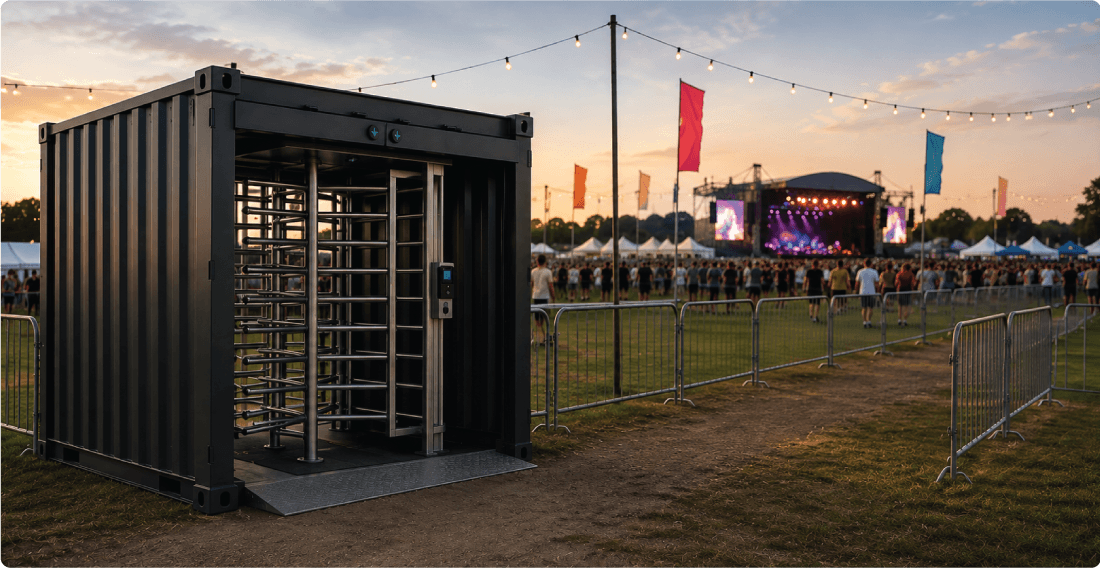

Getting people into a festival efficiently and securely is one of the most underestimated operational challenges in event management. Most of the planning focus goes on the experience inside the site. But it's the entry point that sets the tone for everything, and it's where things go wrong when they haven't been properly thought through.
This guide covers what effective festival/outdoor event access control actually involves, the technology that supports it, and the physical infrastructure that makes it work.
What festival access control actually involves
Access control at a festival or outdoor event isn't just about checking tickets. It's about managing the flow of thousands of people through a limited number of entry points, validating credentials in real time, preventing unauthorised access, and doing all of that without creating queues that stretch back to the car park.
Done well, access control is invisible to attendees. Done badly, it's the thing people remember most.
The components break down into two distinct layers: the technology that validates who can enter, and the physical infrastructure that enforces that decision. Both matter, and the mistake most organisers make is investing in one while neglecting the other.
Where entry points go wrong
The most common failures at festival entry points are as follows: too few lanes for peak arrival periods, credential technology that doesn’t integrate properly with ticketing platforms, and physical setups which allow tailgating or bypassing.
A long queue isn’t just a bad experience, it also creates crowd density issues outside the festival perimeter. This puts extra pressure on security staff, and can set a negative tone before the first act has even performed.
Solving entry problems after the event has started is difficult. The infrastructure and technology need to be right before the gates open.
Ticketing and credential technology
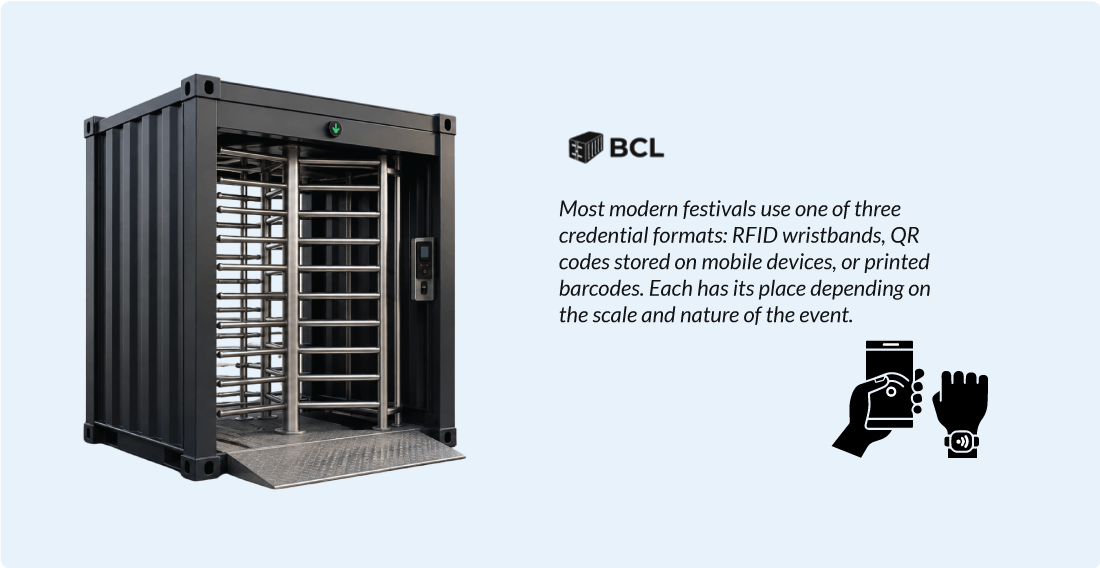
Most modern festivals use one of three credential formats: RFID wristbands, QR codes stored on mobile devices, or printed barcodes. Each has its place depending on the scale and nature of the event.
RFID wristbands are the preferred choice for multi-day festivals. They're difficult to transfer or counterfeit, can be linked to cashless payment systems, and allow real-time monitoring of who is on site and in which zones. For events with VIP areas, backstage access, or restricted zones, RFID allows different permission levels to be assigned to different wristband types.
QR codes on mobile devices work well for single-day events where speed of entry is the priority. Scan times are fast, issuance is instant, and there's no physical item to manufacture or post out in advance.
Whichever format you use, the credential system needs to integrate with your ticketing platform and sync in real time with the readers at your entry points. A credential that can be duplicated and used twice is a significant security failure at scale.
Physical entry infrastructure: What goes at the gate
Many festival access control guides fall short at this point. They cover the technical aspects in detail, but say very little about the physical barrier that controls who passes through.
A credential reader tells a system that the ticket is valid. But without a physical mechanism to enforce that, there’s nothing stopping an unauthorised person from following another through the gate. Security staff can plug that gap to a certain extent, but they are expensive, and cary vary in attentiveness. This can also create a bottleneck when crowd volumes are high.
The solution for serious events is a physical turnstile combined with a built-in credential system. When the reader scans a valid ticket, the turnstile releases, allowing one person through. No human judgement required.
Container turnstiles for outdoor events
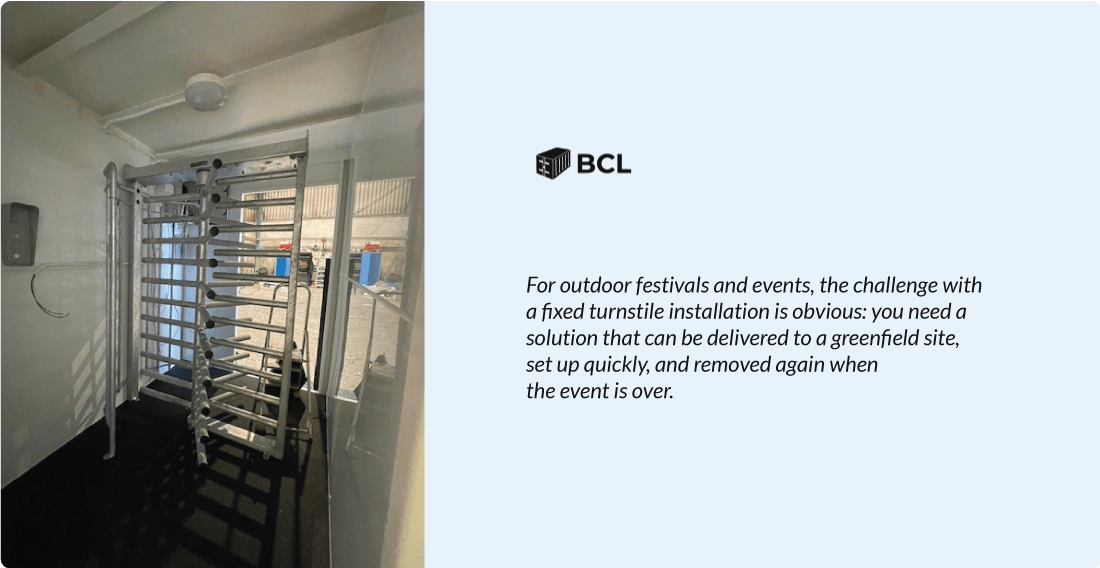
For outdoor festivals and events, the challenge with a fixed turnstile installation is obvious: you need a solution that can be delivered to a greenfield site, set up quickly, and removed again when the event is over.
A shipping container turnstile solves this directly. The turnstile mechanism is built into a converted shipping container, creating a self-contained access control unit that can be transported to site, positioned at the entry point, connected to power, and operational without groundworks or permanent installation.
Because the unit is bespoke, the credential reader, access control system, and any staffed area inside the container are all specified and integrated before delivery. Everything arrives ready to work.
The container format also provides weather protection for both the technology and the staff operating the unit, which matters considerably for outdoor events in the UK. You can see an example of the kind of work we produce in one of our recent turnstile projects.
Full height vs waist height or festival use
The choice between full height and waist height turnstiles depends on the security level required at each entry point.
Full height turnstiles extend from floor to ceiling and cannot be climbed over or bypassed. They're the right choice for main entrances, VIP access points, or anywhere the risk of tailgating is high. The tradeoff is throughput: full height turnstiles process one person at a time and are slower than waist height alternatives.
Waist height turnstiles allow faster passage and are better suited to high-volume general admission entry where speed is the priority and the risk profile is lower. Many events use full height units at the perimeter and waist height at internal zone transitions.
Planning a multi-zone entry layout
Larger festivals benefit from treating access control as a zoned system rather than a single entry point. General admission, VIP, staff, and artist access all have different credential types and different throughput requirements.
Positioning container turnstile units across multiple entry points allows each zone to be controlled independently, with the appropriate credential and turnstile type for that zone. Units can be placed wherever access needs to be managed, without being limited to locations that have existing infrastructure.
For events that run across multiple sites or return year after year, owning the access control infrastructure rather than hiring it each time makes both operational and financial sense. The unit moves with you.
To discuss a container turnstile setup for your next event, get in touch with our team.